Earlier this year I had the pleasure of joining Edward Willett on his podcast, The Worldshapers, where he talks with authors about their latest books. Edward is an accomplished author and publisher himself, and he asks the kind of thoughtful questions that make a conversation go somewhere unexpected. We talked about the Mindweavers series, about writing, and about the strange path that led me from the Air Force to the novel.
From Rocket Science to Washing Cars
After high school I joined the United States Air Force and became a missile telemetry systems analyst. In the years that followed, I lived a life of terribly ordinary jobs: I washed cars, worked in canneries in Northern California, spent a summer as a commercial fisherman, and reported for NBC News in the Sacramento area. Ironically, I went from rocket science to washing cars, which is inversely the wrong way.
I think many young people are looking for the source code, if you will, to the meaning life is supposed to have. What I’ve learned, from washing cars to teaching technology and science, is that reality, in all of its kaleidoscopic forms, is overwhelming, and it never explains itself. There’s no auditor.
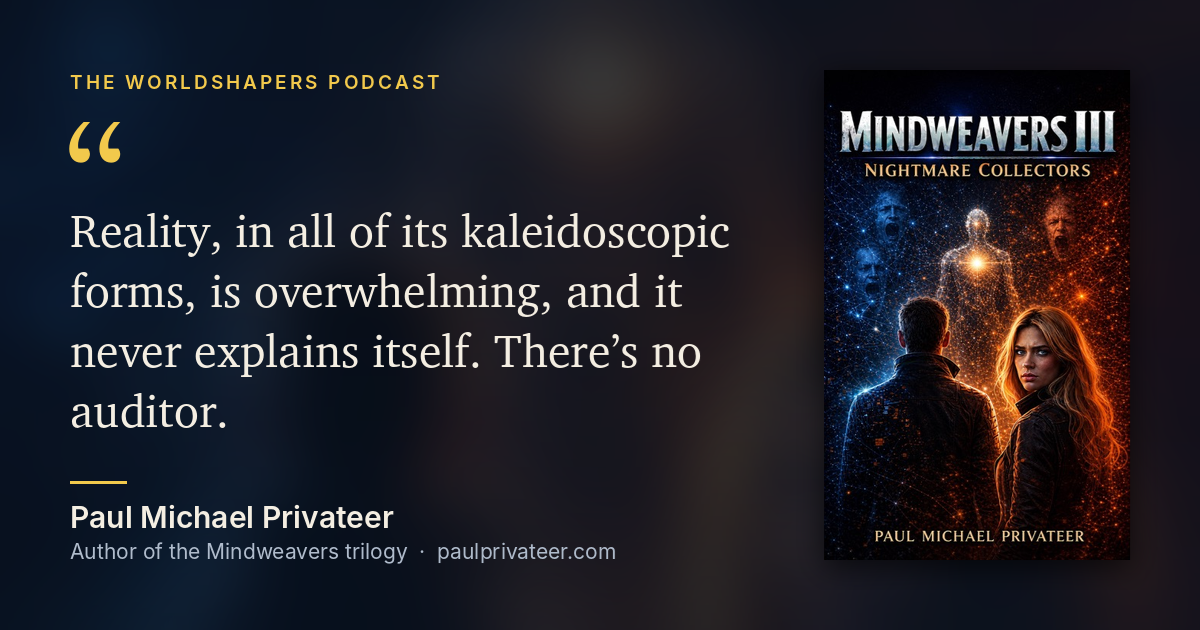
I think many young people are looking for the source code to the meaning life is supposed to have. What I’ve learned is that reality never explains itself. There’s no auditor.
Science Fiction as Allegory
The Time Machine was the first novel I remember reading, when I was seven or eight, and science fiction became almost addictive after that. It opened up the possibility of having an imagination you didn’t have to defend against an adult world telling you to be realistic.
When you read The War of the Worlds at 10 years old, it’s action. When you teach it thirty years later, you realize it’s an allegory. It doesn’t matter whether it’s the Martians. What matters is that some external power is trying not only to control you but to essentially evaporate you. That realization sits underneath everything I write.
Giving Ideas Flesh
In academia, most of what you write might be read by a thousand people at best. I wrote about the construction of identity and about intelligence testing as a mechanism of social control. Once I had tenure, I began to wonder whether those abstractions could be given flesh, whether they could be made human. That’s where Mindweavers began: a story about what happens when the forces of scientific progress eclipse our ability to comprehend them.
My novels rarely start from a single launching point. An idea orbits somewhere in the back of my mind, then another arrives, and eventually four or five or six of those seeds find the cartilage and ligaments that connect them. Once they do, I build a very detailed map, scene by scene, before I write a word. Writing isn’t a muse descending from the Greeks. It’s craft, and it’s hard work.
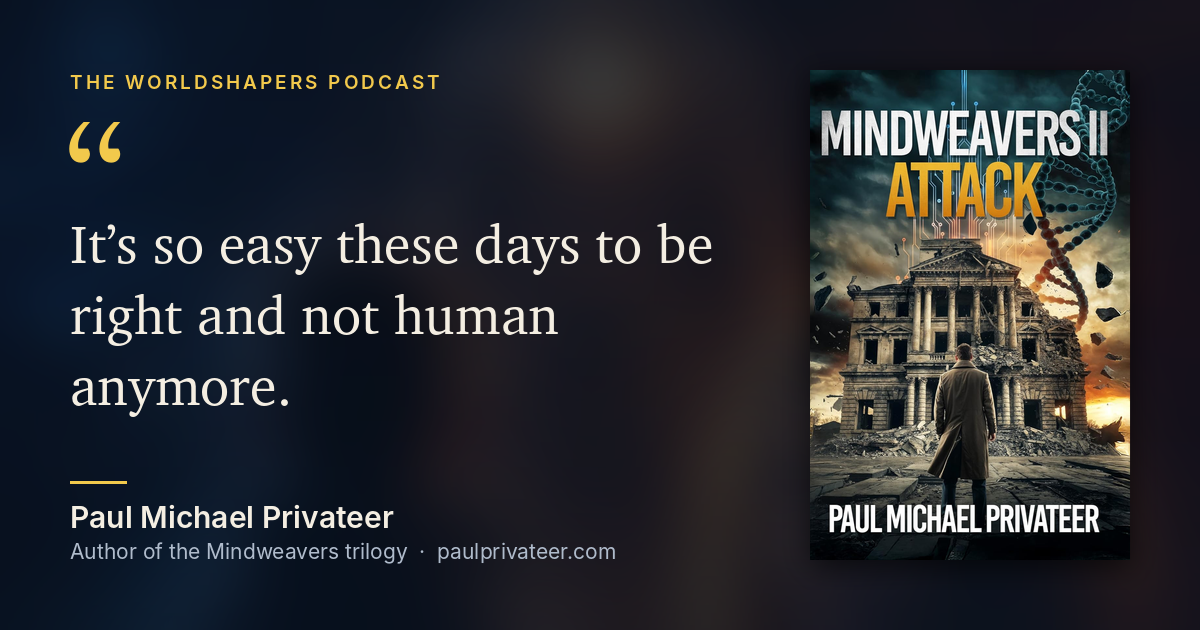
It’s so easy these days to be right and not human anymore.
What I Hope Readers Take Away
Edward asked me what I hope readers come away with from the books. My answer is a better understanding of why it matters so much to be human, and of who controls the definitions of what human is. Those definitions dictate the way people value, believe, and relate to each other. Our need to be right and to have power over others too often outweighs the compassion and kindness we can give one another, and I want readers to be more self-aware about what the world of technology is doing to us.
I also told Edward that I’m firmly opposed to science fiction as a formula, where humanity is nearly destroyed, a savior arrives, and the next story is simply a variation on the same theme. I want Mindweavers to move toward a place where concern yields insight, and insight yields solutions.
The Nightmare Collectors
When we recorded this, the third book was still a work in progress with the working title The Nightmare Collector, and I could only hint at its central idea: an organization learning how people dream in order to shape how they behave. That book is now complete. Mindweavers III: The Nightmare Collectors finishes the trilogy, and I hope you’ll find that it answers some of the questions Edward and I touched on.
My thanks to Edward Willett for a generous, wide-ranging conversation, and to Shadowpaw, the cat his publishing company is named after, for making a memorable cameo late in the interview.